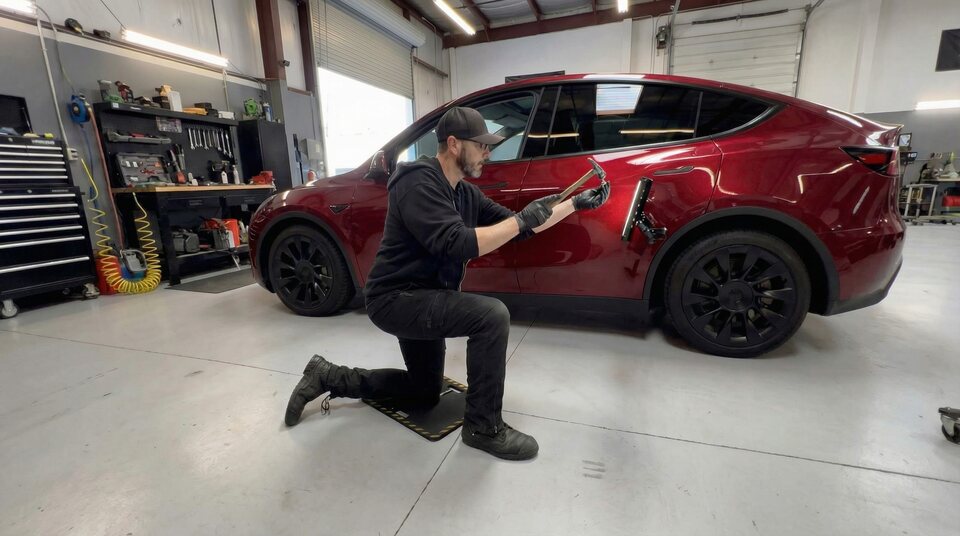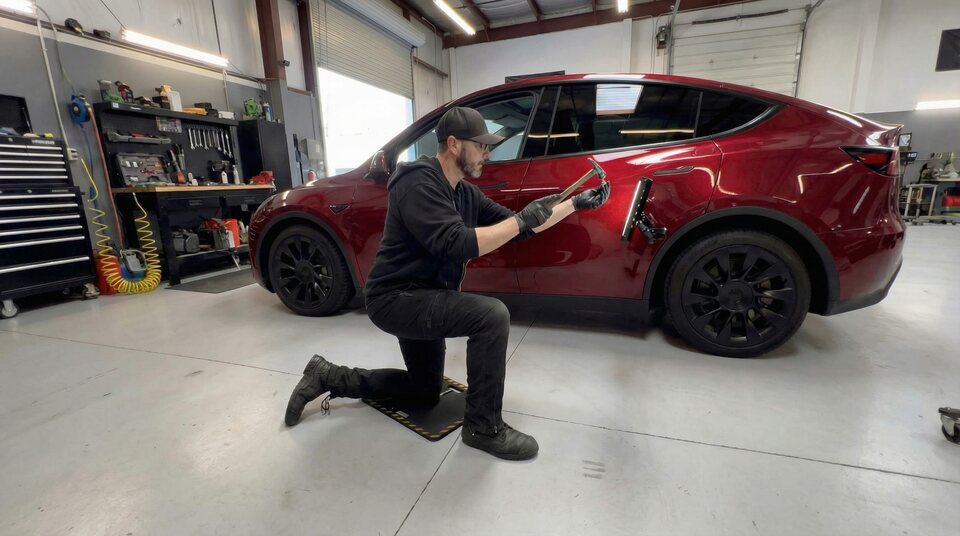
Quick answer: Paintless dent repair (PDR) uses metal rods and picks to massage a dent out from behind the panel — no filler, no paint, no grinding. When the paint is intact and the metal hasn’t been kinked, the dent can be fully removed with the factory finish undisturbed. Most repairs complete same day.
If you live in Glendora, La Verne, San Dimas, or any of the foothill communities east of the 210, you’ve probably seen paintless dent repair mentioned and wondered what it actually is. The name describes it accurately — no paint is involved — but it doesn’t explain the part that surprises most people: that the results are often better than a traditional body shop repair, not just faster and more convenient.
This is a complete breakdown of how PDR works, what it can and can’t fix, and what the process looks like from drop-off to pickup.
The Basics: How Paintless Dent Repair Actually Works
Every dent is a deformation of metal — a section of the body panel has been pushed inward or outward from its original position. The key insight behind PDR is that sheet metal has memory. If the paint is intact and the metal hasn’t been kinked or torn, it can be guided back to its original shape without any cutting, filling, or repainting.
The process works by accessing the back of the damaged panel and using specialized tools to apply precise, controlled pressure from behind the dent. The technician works the metal gradually, making small corrections across the dented area rather than trying to push it back in one motion. At the same time, they use a reflected light source — called a PDR light or dent light — to read the surface of the panel as they work. The reflection of a straight line across the panel makes even tiny high and low points visible, allowing the technician to correct the metal with far more precision than is possible by touch alone.
When the work is done, the metal is back where it was. The factory paint hasn’t been touched. No filler, no primer, no color matching. The dent is gone.
The Tools of the Trade
PDR tools look nothing like body shop equipment. There are no grinders, no spray guns, no mixing cups. The primary tools are metal rods of varying lengths, diameters, and tip profiles — each designed to reach specific areas of specific panels and apply pressure in a specific way.
A typical PDR toolkit includes dozens of individual tools, each suited to a particular access route or dent profile. Long flexible rods reach behind door panels and quarter panels. Shorter, stiffer picks address smaller, more precise areas. Some tools are designed for aluminum panels, which behave differently than steel under pressure and require a lighter touch and different technique.
Alongside the rods, the PDR light is arguably the most important piece of equipment. Without a reliable way to read the surface of the panel during the repair, the technician is working blind. A proper PDR light creates a grid of straight lines that reflect off the panel — any deviation from flat shows up as a curve or kink in those lines. This is how a skilled technician knows exactly where to apply pressure next and when to stop.
Glue-pull PDR is a secondary technique used when a panel can’t be accessed from behind. Small tabs are adhered to the exterior surface of the dent and pulled outward with a specialized tool. The result isn’t quite as precise as traditional rod access, but it can address damage that would otherwise be inaccessible without removing more of the vehicle’s interior.
What PDR Can Fix — and What It Can’t
PDR is not a universal solution for all body damage. Understanding the limits of the process helps you know what to expect from a legitimate assessment. For cases outside PDR’s range, a body shop is the correct path — see our PDR vs. Body Shop guide for the full comparison.
PDR works well on:
- Round or oval dents from hail, shopping carts, minor impacts, and door dings
- Larger smooth dents without sharp creases, such as those from slow-speed bumper contact or panel flex
- Multi-dent scenarios like widespread hail damage, even across many panels
- Aluminum panels on EVs and luxury vehicles, when performed by a technician trained specifically in aluminum — see our EV dent repair page
PDR is limited or not appropriate for:
- Dents where the paint has cracked, chipped, or delaminated at the impact point
- Sharp crease damage along body lines, where the metal has kinked rather than simply deformed — see our crease repair page for these cases
- Damage at the very edge of a panel, where the metal is too close to a seam to be properly massaged
- Previously filled dents — body filler over a dent cannot be re-worked with PDR
- Structural damage or damage that has compromised the vehicle’s frame or reinforcement
An honest PDR assessment will tell you clearly which category your damage falls into. If a portion of the damage is a PDR candidate and another portion isn’t, a good technician will outline the scope precisely rather than overpromising.
Why Glendora and La Verne Drivers Are Choosing PDR Over Body Shops
The foothill communities along the 210 corridor — Glendora, La Verne, San Dimas, Claremont, Upland — have a demographic that tends to take care of their vehicles. Longer ownership periods, newer model years, higher incidence of EV and luxury brands. This is a population that has a real reason to care about factory paint preservation and Carfax integrity.
When a Glendora driver brings a 2022 RAV4 or a La Verne resident’s Model 3 picks up a parking lot dent, the calculation is clear. A body shop repair means repainting a panel, which means a paint thickness reading above stock on that panel for the life of the car, and potentially a repair record in the vehicle’s history. PDR means none of that happens. The car looks right, the history stays clean, and the factory finish that came with the vehicle is the factory finish it leaves with.
There’s also the time factor. Many foothill community residents commute significant distances. A body shop repair for a simple dent can take a week. Same-day PDR means the car is back the next morning. For a working driver, that’s not a minor convenience — it’s a real practical difference in how your week goes.
EV and Luxury Vehicle PDR in the Foothill Communities
Tesla ownership in the Inland Empire foothill communities has grown substantially. Model 3 and Model Y are common on the 210 between Glendora and Rancho Cucamonga. Rivian, Polestar, and BMW EVs are increasingly present as well. These vehicles have one thing in common from a dent repair standpoint: significant amounts of aluminum body panels, and aluminum behaves differently than steel.
Aluminum doesn’t have the same elastic memory as steel. It’s more prone to work-hardening — meaning repeated manipulation without proper technique makes the metal stiffer and more resistant to correction, not more responsive. PDR on aluminum requires specialized tools, a different pressure application approach, and experience with the material before working on a client’s vehicle.
Not every PDR shop in the Inland Empire is set up for aluminum panel work. If you drive a Tesla, Rivian, or any other EV with aluminum body panels and you need dent repair in Glendora or La Verne, see our dedicated EV dent repair page for specifics on what to ask and what to expect.
The Factory Finish: Why It Matters More Than You Think
When a vehicle is painted at the factory, the finish is applied under controlled conditions — temperature, humidity, spray consistency, baking temperature — that can’t be replicated in an aftermarket shop environment. When a body shop repaints a panel, they’re matching color (which they do well with modern scanning technology) but they’re not replicating those underlying conditions. The repainted panel may look identical in normal light. Under direct sunlight or a paint inspection lamp, there’s typically a visible difference in surface texture. And as the vehicle ages, factory panels and repainted panels weather at slightly different rates.
This is why knowledgeable used car buyers and dealers run a paint thickness gauge over every panel of a vehicle they’re evaluating. Factory paint has a predictable, consistent reading across every panel. A repainted panel will show a thicker reading. When they see that reading, they know the panel has been worked, and they price accordingly.
PDR preserves the factory finish completely. Because no paint is removed or added, the thickness readings are unchanged across every panel. A buyer running a gauge over a PDR-repaired vehicle won’t see anything unusual, because there’s nothing unusual to find. To understand how this affects your vehicle’s Carfax and resale value, see our Carfax guide.
What Same-Day Repair Actually Looks Like
You contact the shop with photos of the damage — ideally multiple angles with good lighting that shows the full extent of the dent. A technician assesses the photos and gives you an accurate quote and time estimate. For most standard dents, that response comes back within minutes, not hours.
You bring the vehicle in. The work happens at the shop, where proper lighting and tool access are available for the best result. Most standard repairs are completed within a few hours. Multi-panel or complex repairs may run longer, but the technician will give you a realistic timeframe upfront.
When the work is done, the technician walks you through the repair under proper lighting so you can see the result for yourself. The panel should look right from every angle. If it doesn’t, the work isn’t complete.
You drive away with the original panel, the original paint, and nothing on your vehicle’s record. The dent is simply gone.
How Paintless Dent Repair Works — Frequently Asked Questions
Does paintless dent repair actually work, or is it too good to be true?
It works — for the dents it’s appropriate for. For round or smooth dents where the paint is intact and the metal can be accessed from behind, the results are genuinely excellent. The repair is complete, the factory finish is preserved, and the dent is gone. The “too good to be true” perception usually comes from people who’ve only seen body shop work and assume repainting is always necessary. It isn’t, when the damage is the right kind.
How long does paintless dent repair take?
Most standard repairs take one to a few hours. Larger damage or damage across multiple panels may take a full day. In most cases, same-day service is available — you drop off in the morning and pick up the same day. Unlike body shop repairs that require drying and curing time, PDR has no such constraints.
Will the dent come back after PDR?
No. When metal is properly returned to its original position and the factory paint is intact, the repair is permanent. The panel is physically restored — it’s not being held in place by filler or adhesive that could fail. Dents done right don’t come back. If there’s any question about the quality of a repair, we offer a complete satisfaction guarantee or no charge applied.
Can PDR fix large dents, not just small ones?
Yes. PDR can address significantly larger damage than most people assume. Large smooth dents from slow-speed impacts, extensive hail damage across entire panels, and multi-panel damage are all within the scope of PDR when the damage profile is appropriate. Size alone doesn’t disqualify a dent — the key factors are paint integrity, the profile of the deformation, and accessibility. A photo assessment will tell you quickly what’s possible.
If you’re in Glendora, La Verne, San Dimas, Claremont, or anywhere in the Inland Empire foothill corridor and you have a dent that needs addressing, the fastest first step is to send photos. We assess the damage, tell you honestly what we can do, and give you a close price range within minutes. Send photos to Joe for a free estimate → dentevo.com/get-estimate/ or call (909) 340-3440.