Crease Repair.
Complex Dents Done Without Filler.
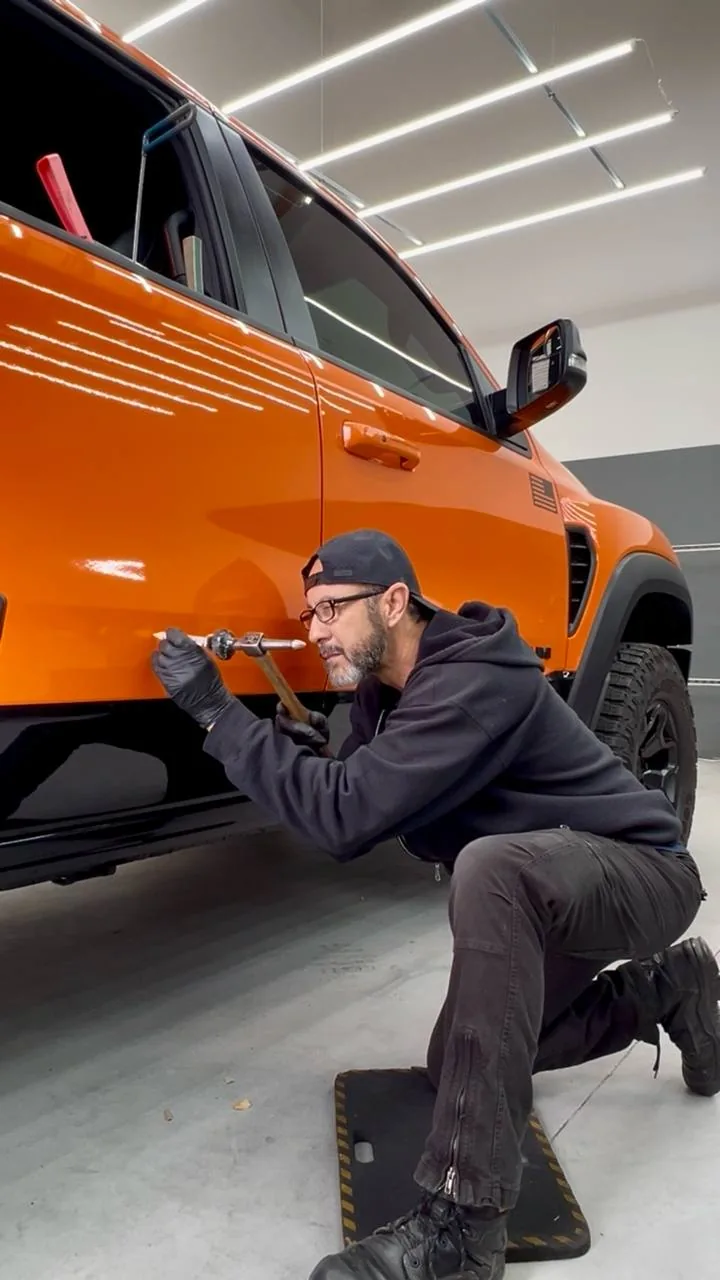
A crease isn’t a simple dent — it’s a fold where the metal has been stretched along a line. That stretched metal has tension in it, and reversing a crease means managing that tension carefully — not just pushing the metal back. Joe has been working complex creases since 1997, restoring panels that most shops would repaint or fill.
Crease running through a body line? Send a photo — Joe will tell you what’s reachable.
The approach changes based on where the crease runs, how sharp it is, and whether it crosses a body line. Understanding the type determines the technique and the outcome.
Body Line Crease
Impact that runs along or through a stamped character line. The trickiest crease to work — the line must be restored precisely or the repair is visible. Joe specializes in these.
Sharp Angle Impact
Damage from a corner, edge, or protruding object that creates a defined fold rather than a smooth depression. Requires controlled working from behind the metal to lift without overshoot.
Door Edge & Panel Corner
Creases at door edges, fender corners, and panel seams from contact with other vehicles or fixed objects. Location near the panel perimeter affects access and technique.
Long Running Creases
Creases that run more than a few inches across a panel — often from a sideswipe or contact with a barrier. Priced by length and repaired in stages to avoid uneven tension in the metal.
Most body shops fill creases with polyester filler and repaint. That hides the damage — but creates new problems that follow the car for life.
Filler Cracks Over Time
Body filler expands and contracts differently than metal. In the Inland Empire’s temperature swings, filler-repaired panels develop hairline cracks within a few years — and those cracks eventually show through the paint.
Repainted Panels Lose Value
A paint-depth gauge detects repainted panels in seconds. Any buyer, appraiser, or dealer inspection will flag it — and that triggers negotiation. Original factory paint invites confidence and full trade-in value.
Color Match Is Never Exact
No matter how skilled the painter, a repainted panel doesn’t match factory paint under all lighting conditions. UV fade and aging make the mismatch more obvious over time.
PDR Removes the Crease
Joe works from behind the panel — no filler, no primer, no paint. The crease is reversed at the metal level. Factory finish is preserved. The repair is permanent because the metal is what’s fixed.
Photo Assessment & Inspection
Joe reviews photos first — length, location, estimated depth, and whether the damage involves a body line or panel edge. This gives him a working picture before the vehicle arrives. In-person, he maps the crease in detail under LED lighting before touching any tool to the panel.
Access & Setup
Depending on the crease location, access may require removing trim, pulling a wheel liner, or working through a factory access hole. Joe assesses access before quoting — access time is factored into the estimate honestly.
Staged Metal Work
Crease repair is done in stages from the center out. Joe works the longest axis of the crease first, reducing it progressively rather than trying to lift the whole thing at once. This prevents new high spots and maintains panel tension evenly.
Detail & Final Check
The finished repair is inspected under raking LED light at multiple angles. The body line must be straight, the panel must be flat, and the paint must be undisturbed. If any of those aren’t true, the work isn’t done.
Photos taken the wrong way make creases invisible. Photos taken the right way give Joe enough information to quote accurately — and avoid surprises when you bring the vehicle in.
Step 2: Position your camera at the same low angle — nearly parallel to the panel surface, not straight-on. Creases are nearly invisible head-on and obvious from the side.
Step 3: Take 2-3 photos from different angles along the crease length. Include one photo from each end of the crease so Joe can see how far it runs.
Step 4: Send to (909) 921-1653 or via the estimate form. Joe responds with an honest assessment within minutes — including whether Advanced Premium PDR or Standard PDR is the right approach for your damage. Learn about Advanced Premium PDR →
Crease dents happen on every vehicle type — from daily drivers and crossovers to luxury sedans, sports cars, and trucks. Joe works all makes.
Joe’s shop is in Upland, CA — centrally located to serve the full Inland Empire and eastern San Gabriel Valley. Most clients are within 20–30 minutes of the shop.
Can paintless dent repair fix crease dents?
What’s the difference between a crease and a regular dent?
How much does crease repair cost?
What if the crease cracked the paint?
How long does crease repair take?
Crease Dent? Send Photos Now.
Text or email photos to Joe. He reviews them personally and responds with an honest assessment — no estimate padding, no surprises.
Get My Free Estimate