If you live in Rancho Cucamonga, Ontario, or anywhere in the Inland Empire, you already know that summer thunderstorms can go from clear skies to quarter-sized hail in under twenty minutes. What most drivers don’t know — until they’re standing in their driveway the next morning counting dimples — is that how you respond in the first 48 hours determines whether that damage quietly disappears from your vehicle’s history or follows the car for the rest of its life.
This is the conversation most body shops hope you never have. Because once you understand what hail damage PDR actually does, and what a traditional body shop repair actually costs you — not just in dollars, but in Carfax records, factory paint, and resale value — the decision becomes obvious.
At Dent Evo, we’ve been doing paintless dent repair in the Inland Empire for decades. This is everything you need to know about hail damage repair in Rancho Cucumonga, Ontario, and the surrounding foothill communities — straight, no fluff.
What a Hailstorm Actually Does to Your Vehicle
A single hailstorm can leave dozens — sometimes hundreds — of individual impact points across a vehicle’s hood, roof, trunk lid, and door panels. Each one is a localized deformation of the sheet metal beneath your factory paint. The paint itself is often fully intact, even when the dent looks bad. That’s the critical detail that determines whether PDR is on the table.
Hail dents are different from collision dents. Collision damage usually involves sharper, more concentrated force — a pole, a fender, a bumper. Hail creates round, smooth depressions with no crease at the center. Because the metal isn’t torn, folded, or kinked, it retains its memory. With the right technique and tools, it wants to go back.
The mistake most drivers make is assuming that because the damage is widespread — maybe thirty dents across the hood alone — the car needs extensive body work. It doesn’t. Widespread hail damage is often more straightforward for an experienced PDR technician than a single deep collision dent, because the impact pattern is predictable and the paint is intact across all of it.
Why Paintless Dent Repair Is Built for Hail Damage
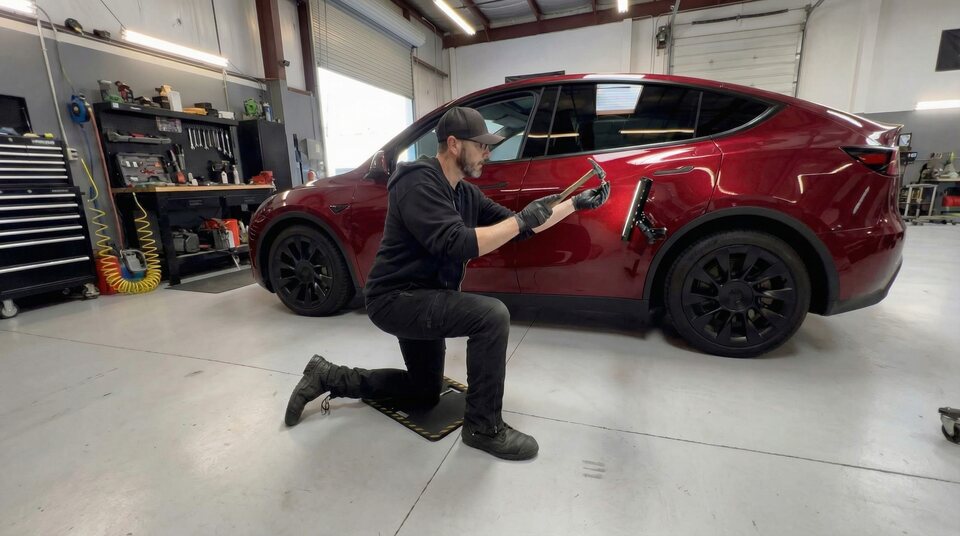
Paintless dent repair works by accessing the back of the damaged panel and using specialized tools to massage the metal back to its original position. No grinding, no filler, no primer, no paint. When it’s done correctly, the dent is gone and the factory finish is exactly as it was — because it was never touched.
For hail damage specifically, PDR is the best repair method available — not just the most convenient, but technically superior. Here’s why:
Factory paint has been applied and baked under conditions that can’t be replicated in a shop. When a body shop repaints a hood, they’re matching color (which they do well) but they’re not replicating the texture, depth, and aging characteristics of the original finish. Over time, repainted panels fade differently than original panels. Knowledgeable buyers — and used car dealers — notice this. A vehicle with all original paint is worth more, period.
There’s also the Carfax dimension. A hail repair at a body shop — particularly one that goes through insurance — generates a record. Depending on how it’s logged, this can show up as accident-related damage or a major repair event on the vehicle’s history report. PDR doesn’t involve paint or body panel replacement, so it doesn’t create that record. Your car’s history stays clean.
And then there’s turnaround time. A body shop handling widespread hail damage can keep your vehicle for two to three weeks. PDR for the same damage — even extensive multi-panel hail — is typically done in a day or two. In the Inland Empire, where most people drive significant distances for work and don’t have time to be without their vehicle, that matters.
The Body Shop Path — and What It Really Costs You
If you take a hail-damaged vehicle to a traditional body shop, here’s what happens: the technician assesses the damage, fills each dent with body filler (or replaces the panel entirely if it’s severe enough), sands, primes, paints, and clears. The car comes back looking good. From a distance, on a lot, it looks great.
But the factory paint is gone on every panel they touched. Any buyer who knows how to run a paint thickness gauge over the panels — and experienced private buyers and dealers do this — will see readings that differ from stock on the repaired sections. That’s a red flag that triggers a price conversation you don’t want to have when you’re selling.
Beyond the paint, the Carfax record is permanent. Once it’s there, it’s there. A vehicle with a clean history report commands a meaningfully different price on the used car market than a comparable vehicle with even one repair event on record. In the Inland Empire, where the used car market is active and buyers are savvy, that gap is real money.
PDR doesn’t create either of those problems. The panels are restored without any material being removed or replaced. The factory paint stays exactly where it was. No record is generated. When you go to sell, the car presents exactly as it should.
What to Do in the First 48 Hours After Hail in Rancho Cucamonga or Ontario
If your vehicle took hail in Rancho Cucamonga, Ontario, Fontana, or anywhere in the west Inland Empire, here’s a practical sequence:
1. Document everything before touching the vehicle. Walk around and photograph every panel in daylight. Low-angle shots with light raking across the surface show dent patterns more clearly than overhead shots. Get the hood, roof, trunk, and all four doors.
2. Contact your insurance company. If you carry comprehensive coverage, hail damage is typically covered. File the claim promptly — insurance companies have timelines for reporting storm damage. Your adjuster will do their own assessment, but having your own photos establishes the condition immediately post-storm.
3. Get a PDR estimate before you commit to anything. Insurance adjusters sometimes default to body shop estimates because that’s the standard model. But you can request PDR as your repair method if the damage qualifies. Many Inland Empire insurance companies work with PDR shops directly — the process is the same, the outcome is better for your vehicle.
4. Don’t let anyone rush you into a repair decision. Fly-by-night hail chasers — operations that show up in parking lots and church lots after major storms — are a real phenomenon in Southern California. Get your estimate from a shop with a permanent address and verifiable local history.
How Long Does Hail Damage PDR Take in the Inland Empire?
The honest answer: it depends on how many panels are affected and the severity of the individual impacts. For a typical Inland Empire hail event — moderate storms that produce nickel to quarter-sized hail — most vehicles can be assessed and quoted in minutes from photos, and repaired in one to two days at the shop.
More severe events, or vehicles with damage across every panel, may take longer. But compared to the two-to-three-week timeline at a body shop dealing with the same damage, PDR is significantly faster across every severity level.
The other variable is demand. After a major hail event that affects a large area, good PDR shops book up quickly. If your vehicle took significant damage, getting your estimate and scheduling sooner rather than later is practical advice, not a sales push.
Two Approaches to Your Hail Repair
At Dent Evo, we offer two levels of repair so you can make a decision that fits your situation.
The Premium repair brings every impacted panel back to flawless — refined under proper lighting from every angle. If you drive a vehicle you care about, plan to keep it for years, or want to maximize resale value, this is the tier that delivers a result you’ll never question.
The Practical repair delivers a clean, professional outcome — the dents are gone, the car looks right at normal inspection distance. If the vehicle is older, you’re planning to trade it in soon, or you simply want the damage corrected without the full refinement process, Practical is a legitimate, high-quality option.
Both tiers preserve your factory paint. Both tiers keep your Carfax clean. The difference is the level of refinement, not the integrity of the approach.
We’ll tell you honestly which tier makes sense for your specific damage and your specific situation. That’s how we’ve operated since day one.
Hail Damage PDR — Frequently Asked Questions
Does insurance cover hail damage PDR in California?
Yes, comprehensive auto insurance covers hail damage in California, including PDR repairs. You’ll pay your deductible, and the insurance company covers the rest up to the repair cost. You have the right to choose PDR as your repair method if the damage qualifies. Many adjusters are familiar with PDR and some insurers actually prefer it because it typically results in lower total repair costs than full body shop work.
Will hail damage PDR show up on my Carfax?
PDR itself does not generate a Carfax record. However, if you file an insurance claim for the hail damage, the claim itself may appear on a vehicle history report. The distinction is important: a PDR repair is far less damaging to your vehicle’s history than a body shop repair involving repainting, because there’s no record of paint or structural work. Many drivers with older vehicles or those who pay out-of-pocket choose PDR specifically to keep records clean.
Can PDR fix deep hail dents?
PDR can address a wide range of hail dent depths, including some that look severe. The key variables are whether the paint is intact and whether the metal can be accessed from behind the panel. Deep dents where the paint has cracked or chipped, or dents on edges and body lines where the metal has kinked rather than simply deformed, may not be PDR candidates. An assessment based on actual photos will tell you definitively.
My whole hood is covered in dents — is that too much for PDR?
Not necessarily. Widespread hail patterns — even hoods with forty or fifty impact points — are often excellent PDR candidates because the damage is consistent and the paint is typically intact across all of it. Extensive coverage doesn’t automatically rule out PDR. What matters is the nature of each individual dent, not the quantity.
How do I know if a PDR shop near me is legitimate?
Look for a permanent physical address, verifiable years in business, and local references or reviews. After major hail events, opportunistic “storm chasers” operate in affected areas — they set up temporarily, do quick work, and move on. A legitimate PDR shop in the Inland Empire has a fixed location, a known history, and a reputation you can verify before you hand over your vehicle.
Can hail damage make my car total-loss eligible?
In extreme cases — large hail, extended duration, a vehicle with lower market value — the cost of repair can approach the vehicle’s assessed value, which triggers a total-loss determination by the insurance company. This is more common with older or high-mileage vehicles than newer ones. PDR’s typically lower repair cost compared to full body shop work can sometimes keep a vehicle below that threshold. It’s worth getting a PDR assessment before accepting a total-loss determination.
If your vehicle took hail damage in Rancho Cucamonga, Ontario, or anywhere in the Inland Empire, the best next step is simple: send us photos. We’ll assess the damage, tell you honestly whether PDR is the right call, and give you a real quote within minutes. Call (909) 921-1653 or submit your photos at dentevo.com/get-estimate/ — a technician responds within minutes, not days.