There are two kinds of Upland car owners: those who’ve come out of a parking lot to find a new dent on their door, and those who will. It’s one of those universal experiences that somehow still catches everyone off guard. You walk to your car, run your hand along the panel, and feel that unmistakable ridge. The other driver is long gone.
What happens next determines whether that dent quietly disappears from your vehicle’s history or follows it to every future buyer, every trade-in conversation, every Carfax pull. Most people wait. They figure they’ll deal with it eventually. That decision costs them more than the repair would have.
This is the complete guide to door ding repair in Upland, Claremont, and the surrounding foothill communities — what causes the most damage, what your options actually are, and why paintless dent repair is the only approach that protects both the car and what it’s worth.
Why a Door Ding Is More Expensive Than It Looks
A door ding looks like a cosmetic issue. It’s not. At the moment of impact, the metal of your door panel deforms outward from the point of contact. The factory paint on that spot is stretched — micro-thin cracks may form in the clear coat even if they’re invisible to the naked eye. Leave it exposed to Upland’s sun and the UV oxidation process begins at exactly the point where the paint is most vulnerable.
That’s the slow damage. The faster version happens when someone opens a door into a panel that’s already been dinged — now you have a fresh impact on weakened metal, and the likelihood of paint cracking increases substantially with each additional hit in the same zone.
The other cost is the one most people don’t calculate until they try to sell. A vehicle with multiple untreated door dings at trade-in time doesn’t negotiate at face value. Dealers know exactly what it takes to restore those panels, and they price that work into their offer — at shop rates, not PDR rates, and with a margin on top. The dent you ignored for two years ends up costing you far more on the back end than it would have to fix on the front end.
The Claremont Village Parking Lot Problem
Drivers in Claremont know the scenario well. The Village draws heavy foot traffic, the lots are tight, and the cars parked there tend to be newer and well-maintained — which means doors get opened with less care than they deserve. The Mission Blvd corridor in Upland has similar dynamics, and downtown Ontario sees it consistently around the weekend market and restaurant district.
Narrow spaces, distracted drivers, kids exiting vehicles, shopping carts left in the path of moving doors — the combination means door ding repair in Upland and Claremont is a steady, predictable need. The variable isn’t whether it happens. It’s what you do about it.
The good news is that the overwhelming majority of parking lot door dings are excellent PDR candidates. The impact is usually shallow, the paint is often intact, and the metal responds well to careful massage back to its original position. These are the repairs that disappear completely when done right.
PDR vs. Body Shop: The Door Ding Decision
If you take a door ding to a traditional body shop, here’s what happens. The technician applies body filler to the affected area, sands it level, primes it, color-matches the paint, sprays, and clears. The result looks good in the lot under flat lighting. Under raking light, a trained eye will see a subtle difference in the paint surface texture. A paint thickness gauge will show a reading above stock on that section of the panel.
More importantly, that repair creates a record. Insurance claims are logged. Body shop repairs show up on vehicle history reports. When you eventually sell or trade in, that record is there — and buyers and dealers use it to negotiate.
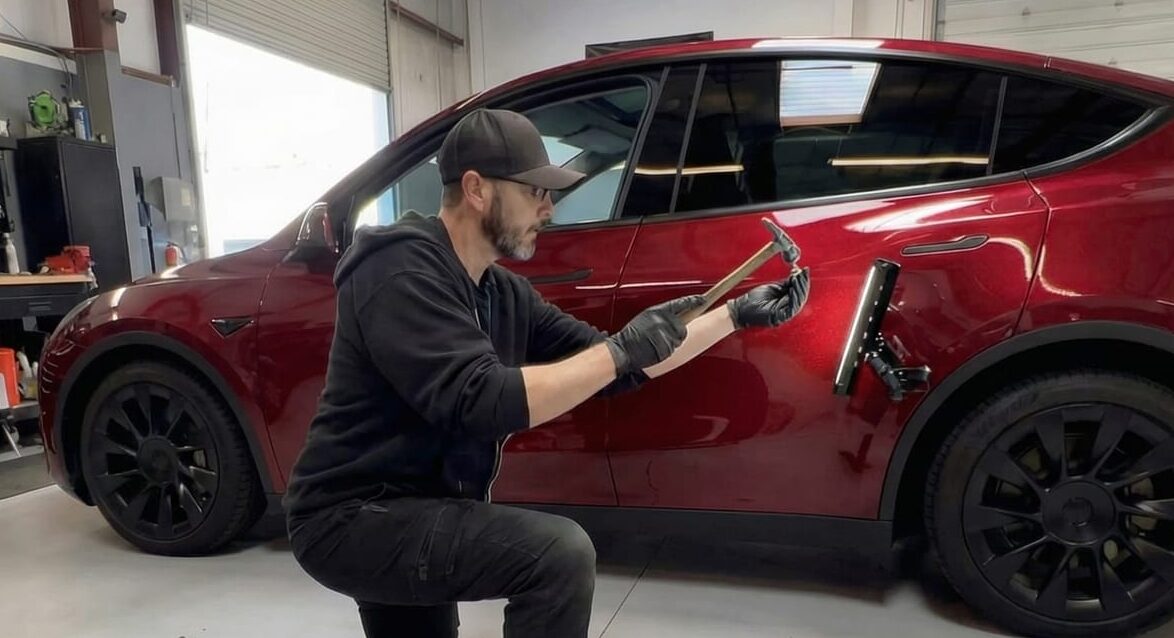
PDR removes the dent without touching the paint. The metal is accessed from behind the panel and guided back to its original shape using precision tools. When the work is done correctly, the factory paint is undisturbed. The dent is gone. Nothing shows on Carfax. Nothing changes about what your car is worth.
For door dings — especially the standard parking lot variety — PDR is not just a convenient option. It is technically the superior repair. You get the original result, not a replacement result.
How PDR Actually Works on a Door Panel
Many people searching for “dent removal near me” or “door ding repair Upland” have never seen PDR up close and aren’t sure what to expect. Here’s the process in plain terms.
The technician first assesses the dent from both sides of the panel — the exterior and the interior — to understand the shape, depth, and direction of the deformation. On a door, access is typically gained by removing the interior door panel or working through a gap. With a light source positioned to reflect off the surface, even small imperfections become clearly visible as the work progresses.
Using a series of precision rods and picks, the technician applies gentle, specific pressure from the back of the panel to raise the low point of the dent. The goal isn’t to push the metal back in one motion — it’s to gradually return it to its original contour through a controlled sequence of small corrections, each one moving the metal slightly closer to flat. As the panel comes up, a technique called glare reading is used continuously: the reflection of a straight line in the panel reveals any remaining high or low points that need attention.
The result, when executed properly, is a panel that is indistinguishable from undamaged. No filler, no paint, no record.
When Paint Is Already Chipped: What Then?
If the impact that created the dent also broke the paint — a sharp ding from a metal shopping cart corner, or a hard door-edge hit on a cold day when paint is more brittle — PDR alone won’t be the complete solution. The dent can still be corrected via PDR, but the paint chip will need to be addressed separately.
Touch-up paint from the manufacturer covers small chips adequately and prevents rust. For larger chips or ones in highly visible locations, color-matching touch-up or spot repaint of the affected area may be appropriate. The key is that PDR and paint touch-up are separate procedures — the dent correction happens first, then any paint work is evaluated independently.
A good PDR technician will be upfront about this. If the paint is compromised and the assessment suggests a touch-up or spot repair is needed alongside the PDR, that’s honest information — not a complication, just the full scope of what the damage requires.
How Long Does Door Ding PDR Take?
Most standard door ding repairs are completed within an hour or two, sometimes less. For vehicles with multiple dings across several panels — a common scenario for a car that’s been in commuter parking for a couple of years — a full day may be appropriate to address everything properly.
This is one of PDR’s most underappreciated advantages for working drivers in the Inland Empire. You drop the car off in the morning, it’s ready the same day, and you pick it up that evening with the panels restored. No rental car, no week-long shop wait, no coordinating logistics around a vehicle that’s out of commission.
Same-day dent repair isn’t a marketing claim — it’s the practical reality of how PDR works for most standard repairs. The process doesn’t require drying time, curing time, or multiple sessions. When the metal is back where it belongs and the quality check is done, the car is ready.
Protecting Your Vehicle After PDR
Once a door ding has been corrected via PDR, the panel is fully restored. There’s nothing special you need to do to protect the repair — the factory paint is intact and hasn’t been compromised by the process. Normal washing, waxing, and paint protection apply just as they did before.
If you want to reduce the likelihood of future door dings in the commuter lots and shopping areas of Upland, Claremont, and La Verne, a few practical habits help: parking at the end of a row where only one adjacent vehicle can reach your doors, choosing spaces next to older or larger vehicles whose door edges are higher than yours, and using door edge guards on high-risk panels. None of these are foolproof, but they reduce the frequency.
The more durable protection is simply knowing that when a ding does happen, you have a repair option that removes it completely and leaves no trace on the vehicle’s history. That knowledge changes how much a door ding costs you — both financially and psychologically.
Door Ding PDR — Frequently Asked Questions
How much does door ding repair cost in Upland, CA?
PDR pricing for door dings depends on the size, depth, and number of dents, as well as the panel location and accessibility. Small shallow dings are typically on the lower end of the range; deeper or multiple dings across several panels are quoted accordingly. The most accurate way to get a price is to send photos — a technician at Dent Evo will assess your specific damage and respond with a real quote within minutes. Call (909) 921-1653 or submit photos at dentevo.com/get-estimate/.
Can paintless dent repair fix door dings completely?
Yes — for most standard door dings where the paint is intact, PDR can restore the panel completely. The result is a panel that is indistinguishable from undamaged. “Complete” is not an exaggeration for well-executed PDR on an appropriate candidate dent. If the paint has cracked or the dent profile includes a sharp crease, the outcome may be very good without being perfectly invisible — an honest assessment upfront will tell you what to expect.
Does door ding repair show up on Carfax?
PDR itself does not generate a Carfax record. If you file an insurance claim for the repair, the claim may appear on a vehicle history report. If you pay out of pocket, there is typically no record created. This is one of the primary reasons drivers with newer vehicles choose PDR for door dings — the vehicle’s history stays clean, which directly protects resale value.
How long does it take to fix a door ding with PDR?
Most single door dings are repaired within one to two hours. Multiple dings across several panels may take a few hours to a full day, depending on the total scope of work. In most cases, same-day service is available — you drop off in the morning and pick up the same day.
What’s the difference between a door ding and a dent?
The terms are often used interchangeably, but a “door ding” typically refers to a small, shallow, round impact — usually from another car’s door. A “dent” can refer to larger or deeper damage from a wider variety of causes. Both can be PDR candidates depending on the specific damage characteristics. The key factors are the same regardless of what you call it: paint integrity, dent profile, and metal accessibility.
Is PDR worth it for an older vehicle?
Often yes, for two reasons. First, a clean-looking vehicle — even an older one — holds its value better in private sales than one with obvious cosmetic damage. Second, the cost of PDR is generally proportionate to the damage, not the vehicle’s age. If the repair restores the panel to a presentable condition and keeps it from worsening, the return on that investment is real regardless of the vehicle’s age. We’ll give you a straight assessment — if PDR doesn’t make sense for a specific situation, we’ll say so.
Door dings don’t fix themselves, and the longer they sit, the more they cost you — not in repair complexity, but in resale value and paint integrity. If your vehicle has picked up parking lot damage in Upland, Claremont, La Verne, or anywhere in the Inland Empire foothill communities, send us photos and get a straight answer. Call (909) 921-1653 or submit at dentevo.com/get-estimate/ — a technician responds within minutes.