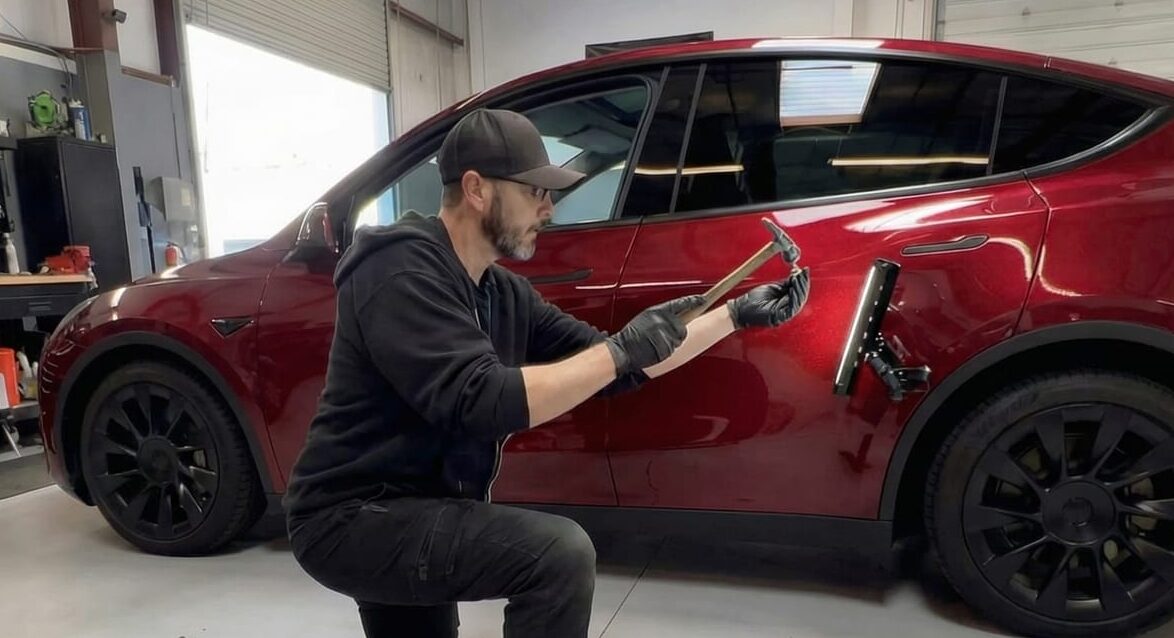
It’s one of the most common questions we hear from Inland Empire car owners: does paintless dent repair show up on Carfax? The short answer is no — but the longer answer is what actually matters, because understanding why PDR doesn’t appear on a vehicle history report is what helps you make better decisions about how you handle any damage to your vehicle, from a door ding in an Ontario parking lot to hail damage after a summer storm in Rancho Cucamonga.
This is a complete explanation of how Carfax works, what actually generates a record, what doesn’t, and how the repair method you choose today directly affects what your vehicle is worth when you sell it, trade it in, or pass it on. If you own a vehicle in the Inland Empire and care about protecting its value, this is one of the most important things you can understand about car ownership.
How a Carfax Report Actually Works
Carfax (and similar services like AutoCheck) compile vehicle history data from a network of sources — state motor vehicle agencies, insurance companies, repair facilities, auto auctions, salvage yards, law enforcement, and others. When any of these sources reports an event tied to a specific VIN, that event is added to the vehicle’s history record.
Not every repair triggers a report. Not every paint job shows up. Not every dent repair creates a record. What gets reported depends on the source of the data — specifically, whether the repair went through a channel that reports to Carfax.
The primary trigger for a damage-related Carfax entry is an insurance claim. When you file a claim for vehicle damage, your insurance company reports that claim to the vehicle history database. The record typically includes the date, the nature of the damage, and the severity categorization. Even if the actual repair is minimal, the claim creates a permanent entry.
The secondary trigger is work performed at certain reporting facilities — body shops and dealership service centers that are in the Carfax reporting network. When they perform specific types of structural or paint work, that work may be reported. Not all shops report, and not all types of work trigger a report, but the risk exists.
Does Paintless Dent Repair Show Up on Carfax?
PDR itself does not generate a Carfax record. Here’s why:
PDR is not a body shop procedure. It doesn’t involve paint, structural work, or panel replacement — the categories of work that body shops report and that insurance companies flag. It’s a metal restoration process performed without materials that trigger the reporting channels Carfax monitors.
If you pay for PDR out of pocket (without filing an insurance claim), the transaction is between you and the repair shop. There’s no insurance company to report the claim, and a PDR shop is not a body shop that reports to Carfax’s network. The repair happens, the dent is gone, and the vehicle’s history record shows nothing — because nothing reportable occurred.
The exception is if you file an insurance claim to cover the PDR repair. In that case, the claim itself may appear on the vehicle history report, even if the actual repair method was PDR rather than body shop work. The claim is the event that gets reported, not the repair technique. This is an important distinction for Inland Empire drivers deciding whether to go through insurance or pay out of pocket for smaller repairs.
What Body Shop Work Does to Your Carfax — and Your Resale Value
When a vehicle goes through a body shop for dent repair — particularly through an insurance claim — multiple things happen to its Carfax record and its market value simultaneously.
The insurance claim is reported. Depending on how the damage is categorized, it may show up as a minor damage event, a moderate repair, or in more significant cases, an accident record. Future buyers will see this entry and interpret it as a red flag, regardless of the actual severity of the original damage.
If the repair involved repainting a panel, that panel now has paint above factory thickness. A buyer using a paint thickness gauge — a standard tool in any serious used car evaluation — will see that reading and know the panel has been worked. This is a negotiating point, and buyers use it aggressively. “This panel’s been repainted” is the start of a price reduction conversation, not the end of one.
The combination of a Carfax entry and a repainted panel can affect a vehicle’s private sale price significantly. Studies from used car market researchers have consistently shown that vehicles with reported damage history sell for less than comparable undamaged vehicles — and the gap widens as the vehicle ages and more buyers become sophisticated about vehicle history evaluation.
In the Inland Empire used car market — which is active, competitive, and buyer-savvy — a clean Carfax is a genuine asset. It’s not just a technicality. It’s money.
The Real Cost of “Just Going Through Insurance”
This is a calculation more Inland Empire car owners should make before filing a claim on smaller damage. Here’s how it typically plays out.
Say your 2021 Tacoma picks up hail damage in a storm near Ontario. You file a comprehensive claim, pay your $500 deductible, and the body shop handles the rest. The car comes back looking good. You’ve paid $500 out of pocket.
What you’ve also done: created a Carfax entry for damage on your vehicle, had multiple panels repainted (body filler, prime, paint, clear), and potentially given your insurance company a data point that affects your future rates. When you go to sell that Tacoma privately or at trade-in two years later, the buyer or dealer pulls the Carfax, sees the hail damage claim, sees the repainted panels on a thickness gauge, and adjusts their offer accordingly. That adjustment can easily exceed the $500 deductible you saved.
Now run the same scenario with PDR. The hail damage is assessed — same storm, same vehicle. PDR is the repair method. If you pay out of pocket, no claim is filed. No Carfax entry is created. The panels are restored to their original metal position without repainting. The factory finish is intact. When you sell or trade in, a buyer runs a gauge over the panels and sees factory readings across the board. The vehicle history report shows nothing unusual. Your negotiating position is entirely different.
Factory Paint: The Asset Most Inland Empire Drivers Don’t Know They Have
Factory paint is not just a cosmetic feature. It’s an asset — one that’s genuinely irreplaceable once it’s gone.
The paint applied at a vehicle’s manufacturing plant goes through a process that no body shop can fully replicate: precise application thickness, specific primer chemistry, a baking process that bonds the finish to the substrate at temperatures and durations that aftermarket booths can’t match. The result is a finish that is chemically and physically integrated with the vehicle in a way that an aftermarket respray is not.
Knowledgeable buyers know this. Certified pre-owned programs know this — CPO inspections include paint thickness checks, and vehicles with panels above factory spec are either disqualified or documented. Auction houses know this. Anyone who buys and sells used cars professionally runs a paint thickness gauge as a matter of course, because factory paint and respray paint are not the same thing and the market prices them differently.
PDR preserves factory paint. That’s not a selling point — it’s a technical description of what the process does. When the metal is restored without any paint removal or application, the factory finish remains exactly as it was. The asset is preserved. When you sell, that preservation is reflected in what the buyer will pay.
How Inland Empire Buyers Think About Carfax and Paint
The Inland Empire used car market is large and sophisticated. Ontario, Rancho Cucamonga, and Upland all have significant used car activity — both dealership and private. The buyers in this market have access to the same tools and information as buyers anywhere, and they use them.
Private buyers in the Inland Empire regularly use apps to run VIN checks on vehicles before they’ll even come to look. They show up with paint gauges. They know what factory paint readings look like on specific makes and models. A vehicle that has had body shop work — even good body shop work — presents differently than a vehicle with all-original paint, and experienced buyers recognize the difference within the first five minutes of an inspection.
Dealers in Ontario, Rancho Cucamonga, and Upland are even more thorough. A dealer’s used car buyer is evaluating multiple vehicles every day. They’ve seen every variation of what body work looks like over time, and they price accordingly. Bringing a trade-in with documented damage history and repainted panels to a dealer is a guaranteed discount conversation. Bringing one with a clean Carfax and factory paint across every panel is a different conversation entirely.
The point isn’t that you’ll get rich by keeping your Carfax clean — it’s that the method you choose to repair dents and damage has a direct, quantifiable effect on what your vehicle is worth to every future buyer it will ever have. PDR protects that value. Body shop work, particularly through insurance, erodes it.
PDR as a Vehicle Value Preservation Strategy
Reframing how you think about PDR changes how you evaluate the cost of any individual repair. It’s not just “how much does it cost to fix this dent?” The better question is “what does it cost me to leave this dent, and what does it cost me to fix it the wrong way?”
Leaving a dent means UV exposure to compromised paint, potential rust initiation in the Inland Empire’s dry climate (which is more corrosive than people assume due to wind-driven debris), and a vehicle that looks neglected at sale time. Fixing it the wrong way — through insurance with a body shop — means a Carfax entry and repainted panels that follow the vehicle permanently.
Fixing it the right way — PDR, out of pocket, on damage where PDR is appropriate — means the vehicle returns to its pre-damage condition in every measurable way. No record. Original paint. Full value preserved. The cost of the PDR repair is offset, often entirely, by the value it protects at resale.
For Inland Empire car owners in Rancho Cucamonga, Ontario, Upland, Fontana, and the surrounding communities who own newer vehicles, EVs, or trucks and SUVs they plan to sell or trade within the next few years, this math matters. PDR isn’t an expense. It’s a vehicle value maintenance decision.
Carfax and PDR — Frequently Asked Questions
Will PDR show up on my Carfax report?
No. PDR itself does not generate a Carfax entry. The only scenario where a PDR repair might appear on a vehicle history report is if an insurance claim was filed for the damage — in which case the claim (not the repair method) may be reported. Out-of-pocket PDR repairs with no insurance claim involvement leave no Carfax record.
Does it matter that I went through insurance for a previous repair?
Yes, it matters in the sense that the claim record exists and future buyers may see it. But the impact varies significantly depending on how the damage was categorized and repaired. If the original repair was PDR rather than body shop work, you can honestly tell a buyer the vehicle’s paint is all original — which is a meaningful data point alongside the insurance record. Going forward, evaluating each damage event on its own merits before deciding whether to file is the best strategy.
Can a buyer tell if my car has had PDR done?
A paint thickness gauge will not detect PDR — the factory paint thickness is unchanged. The only way to detect PDR is through very close examination under ideal lighting by someone specifically trained to find it, looking for minor imperfections in the surface. In practice, a high-quality PDR repair is functionally undetectable to buyers, dealers, and even CPO inspectors. Body shop work, by contrast, shows up immediately on a paint thickness gauge.
Should I go through insurance or pay out of pocket for a dent?
It depends on the scope and cost of the repair relative to your deductible, and how much you value keeping the Carfax clean. For smaller damage — door dings, minor dents, limited hail — the math often favors out-of-pocket PDR. For extensive damage where repair costs significantly exceed your deductible, insurance becomes more appropriate. The first step is always getting a PDR estimate so you know the actual repair cost before making the insurance decision.
What is a paint thickness gauge and why do buyers use it?
A paint thickness gauge is a handheld electronic tool that measures the depth of paint on a vehicle’s panels. Factory paint has a predictable, consistent depth across all panels of a given make and model. Panels that have been repainted — through body shop work — show higher readings because additional material (primer, paint, clear) has been applied over the original surface. Experienced buyers use this to quickly identify which panels have been worked, even when the paint looks perfect to the eye.
Does PDR affect my car insurance rates?
Not directly. Insurance rates are affected by claims, not by the repair method. If you pay for PDR out of pocket without filing a claim, your insurance company has no knowledge of the repair and your rates are unaffected. Filing a comprehensive claim for the damage may affect rates at renewal depending on your insurer’s policies, regardless of whether the repair was PDR or body shop work.
How does Carfax history affect trade-in value?
Documented damage history on Carfax is a concrete negotiating point for dealers. The exact impact varies by the nature and severity of the reported event, the make and model of the vehicle, and market conditions — but dealers consistently use Carfax entries to justify lower offers. A clean Carfax doesn’t guarantee a top offer, but a damaged one almost guarantees a reduced one. Protecting the record on vehicles you plan to sell or trade within three to five years is a financially sound decision.
If you have damage on your vehicle and you’re weighing your options — insurance vs. out-of-pocket, PDR vs. body shop — start with the PDR assessment. Know your actual options and costs before making the insurance decision. Send photos to Dent Evo and a technician will respond within minutes with a real quote and honest guidance on whether PDR is the right call for your specific damage. Call (909) 921-1653 or submit at dentevo.com/get-estimate/.